01
Overview
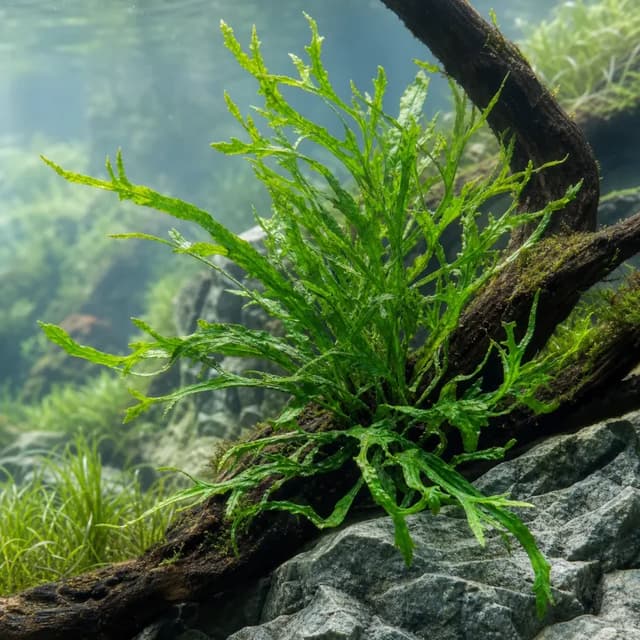
In the wild it clings to rocks in splash zones and stream margins from India to the Philippines, sometimes fully submerged, sometimes just misted. That amphibious history is why it accepts almost any aquarium: hard water, soft water, dim corners, and rough fishkeeping all included.
02
Aquascaping use
A mature stand makes a fine-textured green wall behind driftwood, softening hardscape without demanding substrate space. In cichlid and goldfish tanks it is often the only plant that survives, tied to rocks the fish cannot uproot.
03
Planting
Tie or glue the creeping rhizome to hardscape; within a couple of months its wiry dark roots will grip on their own. Never plant it in substrate, which suffocates the rhizome.
Attach to rock or wood
04
Light & CO₂
Low light is fully sufficient, and it lives happily in the shade of taller plants. CO₂ produces denser, larger leaves but changes nothing about its survival.
05
Substrate & fertilization
It feeds from the water column, so a simple all-in-one fertilizer covers it. Chronic potassium shortage shows as pinholes that spread into cracks along old leaves.
Feeding behavior: Water-column feeder. Nutrient demand: low.
06
Growth, trimming & propagation
Cut whole leaves at the rhizome rather than shortening blades, which never heal cleanly. Pluck the plantlets that form on old leaf tips and attach them wherever you want the next colony.
Rhizome division and plantlets
07
Common problems
- !Black sori dots on leaf undersides are reproduction, not disease
- !Pinholes in old leaves often signal potassium deficiency
- !Melts if the rhizome is buried in substrate