01
Overview
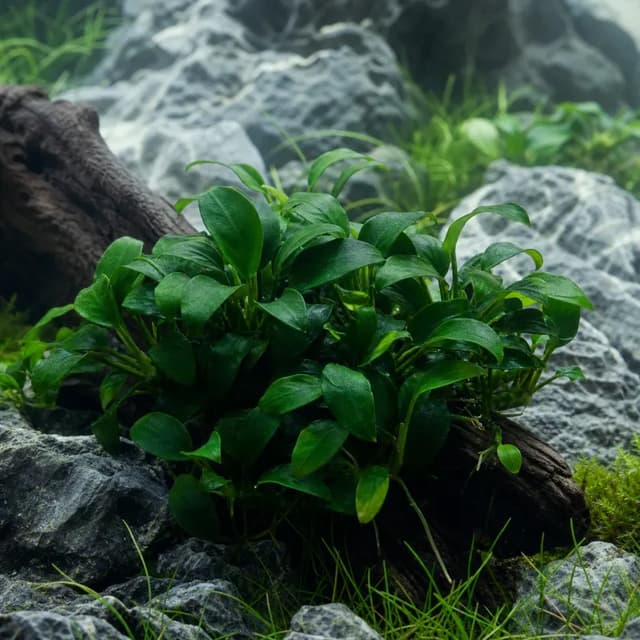
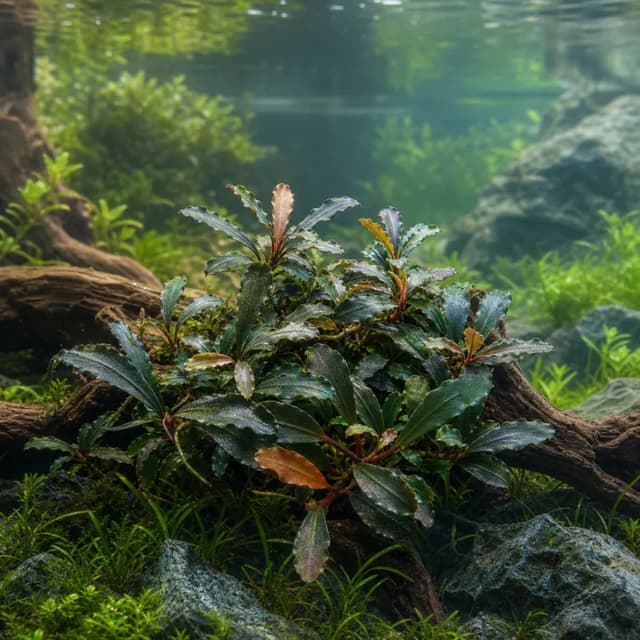
The pleated leaf surface is what sets this form apart, catching light in ridges the way espresso crema holds a swirl. New leaves emerge a warm brown and darken over several weeks, so a healthy plant always carries two colors at once.
02
Aquascaping use
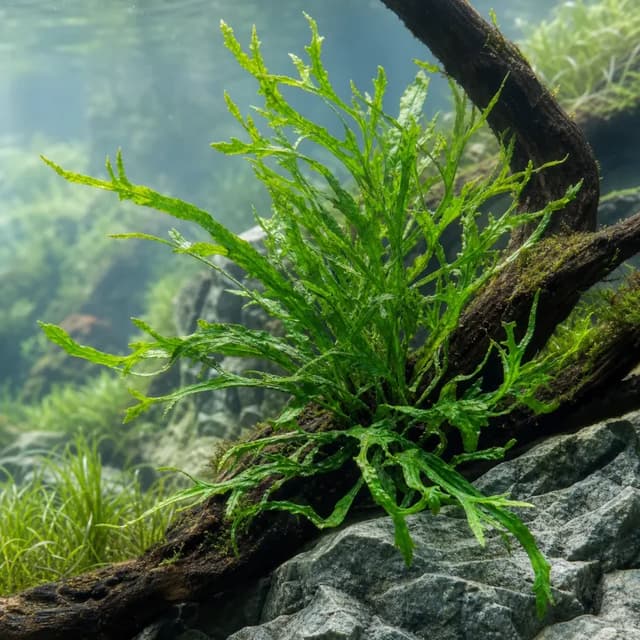
Use it where the corrugated texture can be seen at an angle, ideally elevated on wood at mid-height rather than tucked at the substrate line. It pairs well with fine ferns and mosses that exaggerate its heavy, sculpted look.
03
Planting
Attach the rhizome to bark or porous rock; the ridged leaves shed debris better when the plant sits tilted rather than flat. Leave room in front, because mature leaves arch outward further than the young plant suggests.
Attach to hardscape
04
Light & CO₂
Low to moderate light preserves the contrast between brown new growth and dark older leaves. It ignores CO₂ injection for survival purposes, though enriched tanks produce somewhat larger leaves.
05
Substrate & fertilization
Steady water-column micronutrients keep the emerging leaves richly colored. There is no need for substrate feeding at any stage.
Feeding behavior: Water-column feeder. Nutrient demand: low.
06
Growth, trimming & propagation
Prune old leaves flush with the rhizome and resist frequent division; this cultivar sulks longer than plain barteri after being split. When you do divide, keep each piece generously sized.
Rhizome division
07
Common problems
- !Slow recovery after division or transport
- !Algae films settle into the leaf ridges under strong light
- !Buried rhizomes rot like all Anubias