01
Overview
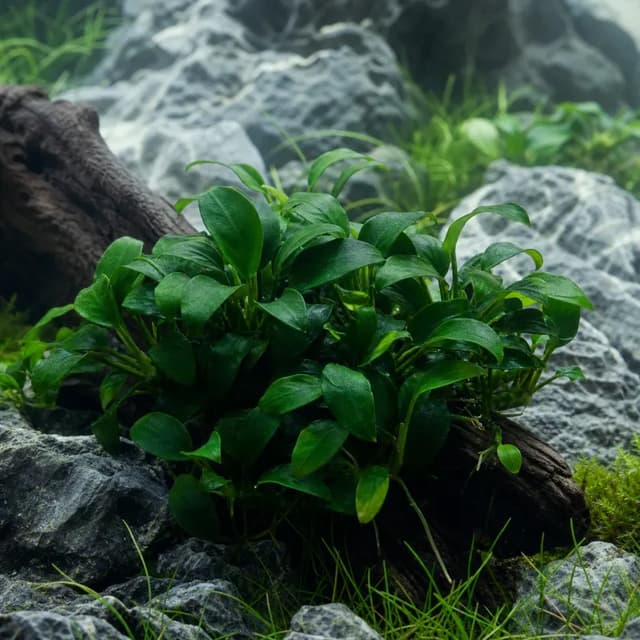
In West African streams this plant grows on rocks and roots at the waterline, often half emersed, which explains both its tough leaf structure and its patience with almost any aquarium. Expect a handful of new leaves per year rather than visible weekly growth; that slowness is the trade for its near indestructibility.
02
Aquascaping use
Its leaves are large enough to read as a focal shrub in mid-sized tanks, so treat it like structure rather than filler. It sits naturally at the base of driftwood where a trunk meets the substrate, hiding the joint the way it hides stream banks in the wild.
03
Planting
Tie or glue the rhizome to rock or wood and let the thick white roots find their own grip; they will cement themselves to hardscape within weeks. If you must place it low, rest it on the substrate surface rather than burying the rhizome.
Attach to rock or wood
04
Light & CO₂
Low light is genuinely enough, and strong light is actively risky because the long-lived leaves become algae real estate. CO₂ injection speeds things up slightly but is wasted on a plant this deliberate.
05
Substrate & fertilization
A lean, consistent water-column dose covers its needs; it takes nutrition through leaves and exposed roots rather than the substrate. Skip root tabs unless neighbors need them.
Feeding behavior: Water-column feeder. Nutrient demand: low.
06
Growth, trimming & propagation
Cut spent leaves at the base with a clean blade rather than tearing, because wounds on the rhizome invite rot. Divide by snapping the rhizome into sections with at least four or five leaves each.
Rhizome division
07
Common problems
- !Old leaves collect green spot algae under strong light
- !A buried rhizome softens and rots
- !Sudden melt after replanting usually traces to a damaged rhizome, not water chemistry